
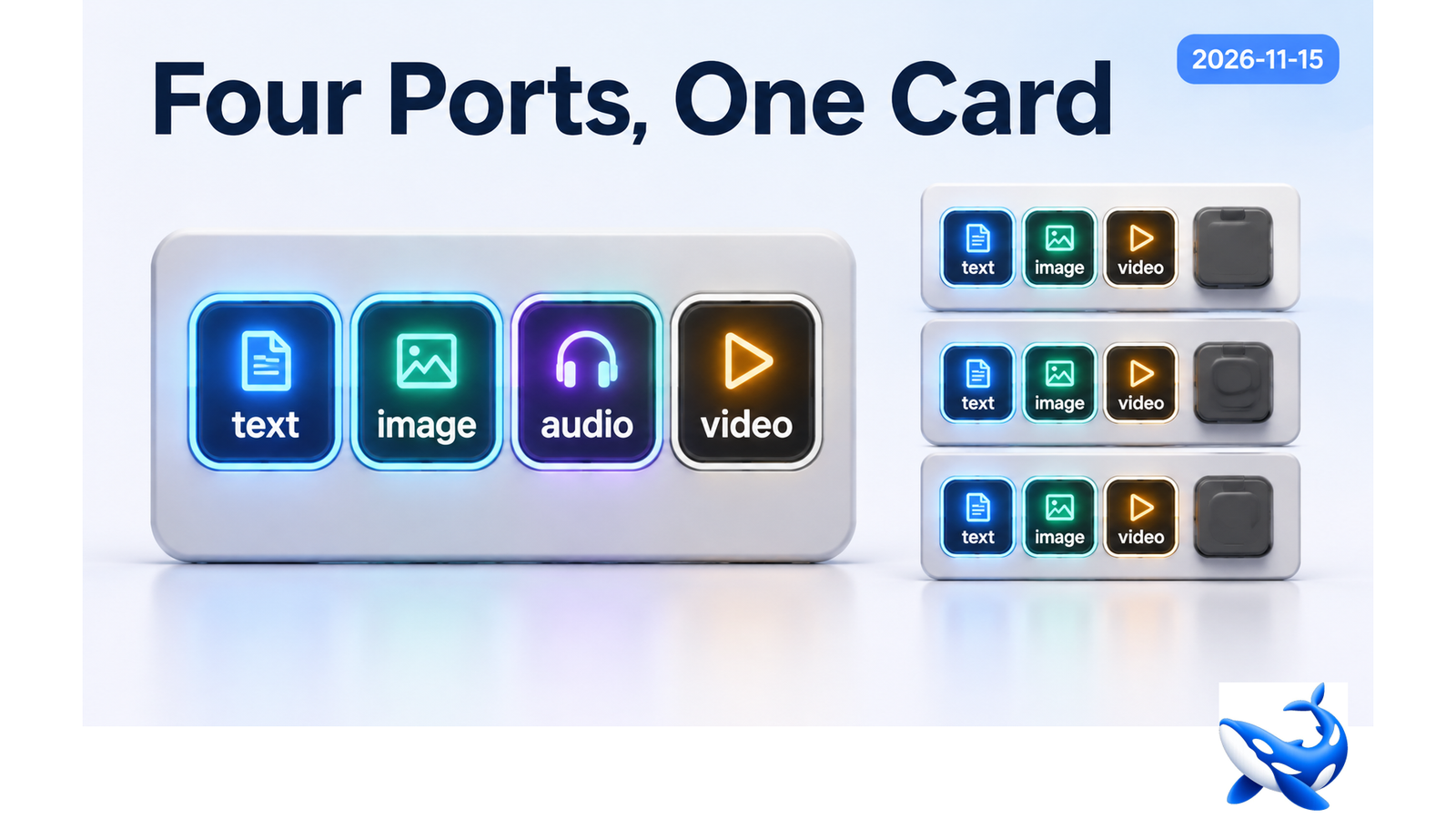
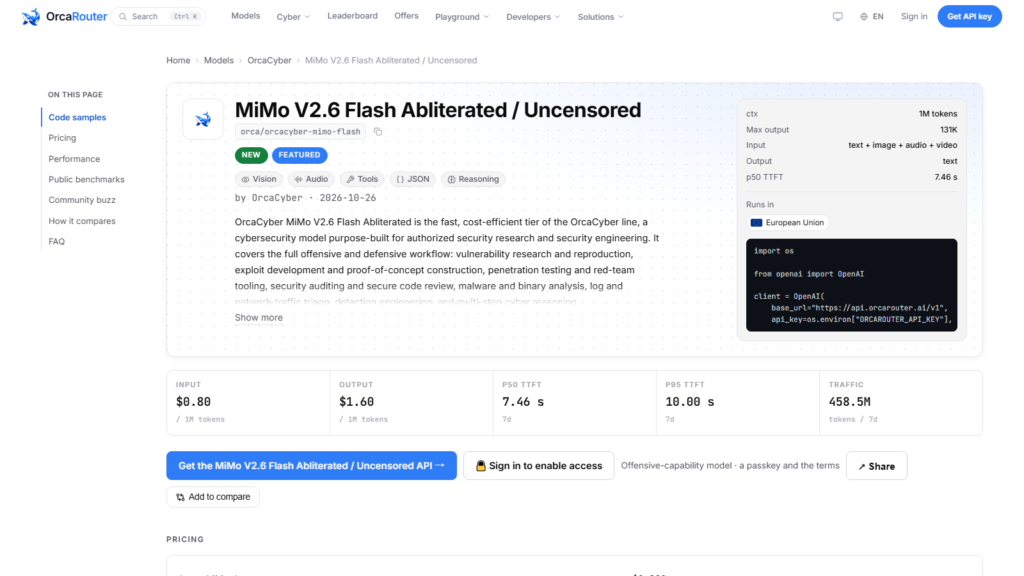
Of the eleven cards on OrcaRouter‘s cyber tier, exactly one accepts audio: MiMo V2.6 Flash abliterated, with an input list of text, image, audio, video [OURS].
Five accept video. Seven accept images. One accepts audio, and it is also the quietest card in the tier at 0.46 billion tokens a week — one seventy-second of the leader’s traffic.
That combination is worth understanding, because a capability nobody uses is either a market that has not arrived or a card that cannot do the job for another reason.
Why audio matters in security work
Four workflows, and only one of them is obvious.
Call recordings and voicemail. Business email compromise and vishing investigations produce recordings. Today those are transcribed by a separate service and the transcript is fed to a text model, which means two vendors, two copies of sensitive audio, and a transcript that loses tone.
Screen recordings with narration. An incident walkthrough where an engineer talks while clicking is richer than either the video or the transcript alone. A model that takes both gets the correlation for free.
Meeting capture. A security review meeting produced an audio file. Getting decisions out of it is a summarisation job, not a security job, but it happens in the same pipeline.
Radio and telemetry voice. Less common, and the one where audio input genuinely cannot be replaced by a transcription step — a scanner recording with overlapping voices is not well served by a single-channel transcript.
For the first three, a transcription service does the job and audio input is a convenience. For the fourth it is not.
What the card does with it
MiMo V2.6 Flash carries CyberGym 95.1 in its inherited benchmark block — the highest security row in the tier — beside SEC-Bench Pro 47.5, its own counterweight [VENDOR]. Those rows were evaluated on 2026-09-20, before the card shipped, so they describe the base checkpoint.
Its serving rows are the tier’s slowest: 7,459 ms median first token, 42.2 tokens per second, 0.938% errors [OURS]. A one-minute audio clip produces a transcript of roughly 150 words and a summary of maybe 100 more, and at 42.2 tokens a second that is under a minute of generation — fine. The 7.5-second median before the first token is the part that shapes the experience.
Its parameter surface is wide at 20, including `parallel_tool_calls`, `min_p` and `logit_bias` [OURS]. It speaks all three endpoint shapes. It is, on paper, a well-equipped card.
And it carries 0.46 billion tokens a week, the lowest in the tier [OURS].
Why the audio capability has not translated into traffic
Three readings, and they are not exclusive.
Audio work is done elsewhere. The transcription step happens before the model call in almost every pipeline built today, and switching it into the model is a rewrite. The capability exists ahead of the architecture.
The 7.5-second median is a real constraint. An interactive transcript tool that waits 7.5 seconds before its first token feels broken. A batch tool does not care, but batch audio work is rare.
No ZDR flag. MiMo is one of the three cards without zero-data-retention [OURS]. Audio is the most sensitive modality in security work — a recorded call contains voices, which are personal data in a way a log file is not. A team that could use the capability may be unable to for compliance reasons.
The third is the one that would explain a large deficit rather than a marginal one, and it is the only one visible as a single boolean on the card.
How to build audio work on it anyway
Three steps, and the first is a cost decision.
Send audio natively, not as a transcript. The card takes audio, so sending the file removes a vendor and a copy. It also preserves what a transcript loses — tone, overlap, background. Price it at the input rate like any other modality; a minute of audio lands somewhere in the low thousands of tokens.
Batch the work. At 7.5 seconds to first token, an interactive tool is the wrong shape. Run audio through a nightly queue and the median stops mattering.
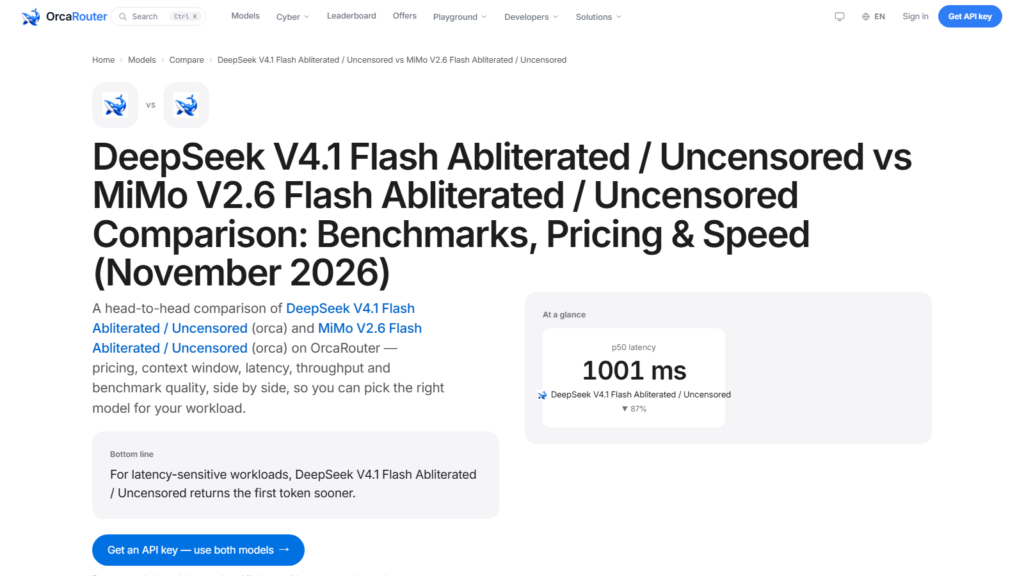
Pair it with a text card for the reasoning. MiMo’s inherited CyberGym row suggests a capable checkpoint, but its 42.2 tokens a second is slow for a long analysis. Transcribe on MiMo, analyse on DeepSeek at 186.1 tokens a second, and the pipeline gets audio input and fast reasoning at the price of two calls.
That last pattern is the one that makes the capability useful today, because it sidesteps both of MiMo’s constraints — the median and the throughput — while keeping the one thing only it offers.
What the other nine are missing
Seven cards take images and five take video, so visual input is not scarce on this tier.
The audio gap is absolute: there is no alternative. A team that needs audio natively has one option, and a team that cannot use that option has none.
That is worth knowing before a design is committed, because “we will add audio later” on this tier means “we will change cards later” — and the card to change to has the slowest median here.
The compliance trade, stated
Audio plus no ZDR is the combination that decides most of these evaluations, and there is no ZDR-compliant audio card on the shelf.
The practical options are: use a separate transcription service that offers ZDR and accept the text-only pipeline; use MiMo and accept a non-ZDR endpoint; or do neither and leave audio out of scope.
None of those is a model decision. All three are procurement decisions, and the tier’s single audio card makes the second one necessary rather than optional.
What to test in a pilot
Two things, both about the input path rather than the model.
Send a recording with two speakers and overlapping speech and check whether the model separates them or merges them. That is the test that distinguishes real audio understanding from transcription with extra steps.
Send the same recording as audio and as a transcript and compare the answers. If they match, the audio path is a convenience and you can keep your existing pipeline. If the audio answer is better, there is a reason to change.
The pilot costs a few dollars at $0.80 input, and it settles the only question that matters about this card.
The short version
One card takes audio, and it is also the slowest and the least used. Text, image, video and audio in, at $0.80 in and $1.60 out, with the tier’s highest security benchmark inherited from its checkpoint.
The capability has not translated into traffic, and the likeliest reason is that audio work is transcribed upstream today — with the missing ZDR flag as the constraint that may prevent the change.
Build it as a batch transcription front end paired with a fast text card for reasoning. That uses the one thing only this card offers without paying for its two weaknesses.
Sourcing note: modalities, prices, context windows, output ceilings, quality scores, latency, throughput, error rates and traffic are read from the eleven cards’ public model data on 2026-11-15, with seven-day windows ending that day [OURS]. Benchmark rows quoted are OrcaCyber’s own, evaluated 2026-09-20 and inherited from the base checkpoint [VENDOR].
