
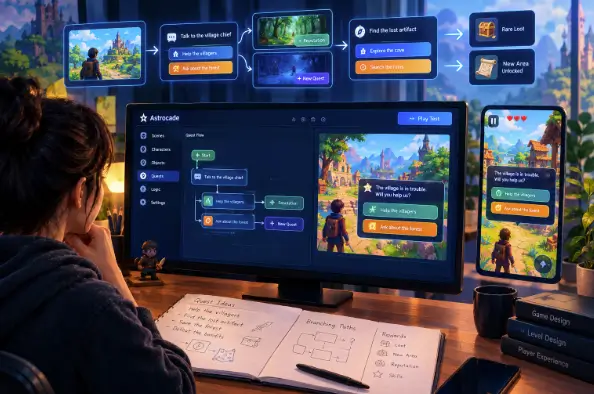
A good quest does more than send a player from one point to another with a checklist of tasks in between. It gives them a reason to care about the journey, a sense that their choices along the way actually matter, and a payoff that feels earned rather than automatic. Designing quests like that has traditionally required real technical effort to implement branching logic, track objectives, and tie rewards to specific player actions. No-code game makers are making that kind of interactive quest design realistic for creators who have a strong sense of what makes a quest compelling but no background in the programming it used to require.
Why Good Quests Are Harder to Design Than They Look
A Checklist Isn’t the Same as a Compelling Quest
Many quests amount to little more than a list of objectives to complete in sequence, go here, collect this, return. Without a reason for the player to actually care about what they’re doing, a quest can technically function while still feeling like busywork rather than a meaningful part of the game.
Branching Logic Multiplies Complexity Quickly
Once a quest includes player choices that affect its outcome, the underlying logic required to track and respond to those choices grows considerably. Even a quest with just a few decision points can require significant behind-the-scenes tracking to make sure every path resolves correctly.
What Makes a Quest Genuinely Interactive
Choices That Actually Affect the Outcome
A quest feels interactive when the decisions a player makes along the way lead to noticeably different results, not just cosmetic differences in how the same ending is reached. If every path eventually converges on an identical outcome, players quickly learn that their choices within the quest don’t carry real weight.
Objectives Tied to the Game’s Core Mechanics
Quests that require players to engage with the game’s actual core mechanics tend to feel more integrated than ones that exist as a separate layer disconnected from everything else. A quest built around mechanics the player already understands and enjoys reinforces the core experience rather than interrupting it.
Rewards That Reflect the Effort Involved
A quest’s payoff needs to feel proportional to what it actually asked of the player. A lengthy, multi-stage quest that ends with a reward identical to a much simpler task can leave players feeling like their investment wasn’t properly recognized.
How No-Code Tools Make Interactive Quest Design More Accessible
Building Branching Logic Without Writing Code
No-code game makers let creators set up branching objectives and conditional outcomes through visual systems or plain language descriptions, rather than manually coding the tracking logic themselves. A creator can specify that a particular choice leads to a different quest outcome without needing to understand how that branching is implemented behind the scenes.
Testing Multiple Quest Paths Quickly
Because no-code tools speed up implementation, creators can test how different branches of a quest actually play out much faster than manually building and debugging each path individually. This makes it realistic to design quests with genuine branching rather than defaulting to a single linear path simply because branching was too costly to implement and test.
Iterating on Pacing and Objective Design
Quest pacing, how quickly objectives unfold, how much is asked of the player before a payoff arrives, often needs adjustment once it’s actually played rather than just planned. No-code tools make it faster to test and refine this pacing without rebuilding the quest’s underlying structure each time.
Building Interactive Quests on a No-Code Platform
Having the ability to describe branching logic in plain language only matters if there’s a platform that can actually turn that description into something playable.
A Platform Suited to This Kind of Quest Design
Astrocade is a good example of a no-code game maker that lets creators build quests with real branching and conditional outcomes without needing to write the underlying tracking logic themselves. This removes much of the technical barrier that used to make genuinely interactive quest design impractical for smaller creators.
Seeing Quest-Driven Design in a Real Game
Rage Unleashed: Green Rampage is a good example of a game built around a clear, focused objective structure that gives players a specific goal to work toward. Even in a more action-oriented game like this, having a defined sense of purpose behind what the player is doing helps the experience feel more directed than an open-ended setup with no clear objective.
What Still Requires Human Design Judgment
Deciding Which Choices Are Worth Branching
AI and no-code tools can help implement branching quickly, but they can’t decide which specific decision points actually deserve meaningful divergence. Adding branches indiscriminately can dilute the quests that genuinely benefit from player choice, so recognizing where branching adds real value remains a design call.
Keeping Quest Pacing Aligned With the Broader Game
A quest that’s paced well in isolation can still feel mistimed if it doesn’t fit naturally into the broader flow of the game around it. Making sure individual quests support the overall pacing of the experience is a judgment call that depends on understanding the game as a whole.
Making Sure Rewards Feel Earned, Not Arbitrary
Setting the right reward for a given quest’s length and difficulty requires a sense of player expectation that AI-assisted tools can support through testing but can’t fully determine on their own.
Common Mistakes When Designing Interactive Quests
Adding Branches Without Meaningful Differences
It’s possible to build a quest with multiple paths that all lead to functionally identical outcomes, which creates the illusion of choice without the substance. Players tend to notice this quickly, and it can undermine trust in future choices presented within the game.
Overcomplicating Early Quests
Introducing heavily branching, complex quests too early in a game can overwhelm players before they’ve built a mental model of how the game’s systems work. Simpler objectives early on, with more complexity introduced gradually, tend to land better.
Skipping Playtesting on Every Branch
With multiple paths through a single quest, it’s easy to thoroughly test one path while leaving others under-tested. Each branch needs its own playtesting pass to confirm it holds up, since issues on a less-traveled path are easy to miss if only the most obvious route gets checked.
A Practical Approach to Designing Interactive Quests
A reasonable process looks like this. Identify which specific decision points in a quest genuinely benefit from branching outcomes, rather than adding branches throughout for their own sake. Use a no-code platform to build and test those branches quickly, confirming that each path feels distinct rather than cosmetically different. Tie objectives to the game’s core mechanics wherever possible, and make sure rewards scale appropriately with the effort and complexity involved in reaching them. Test every branch individually rather than assuming the most obvious path represents the full experience.
Final Thoughts
An interactive quest earns its name by giving players choices that actually matter, not just a longer checklist to complete. No-code game makers are making this kind of branching, consequence-driven quest design realistic for creators without a programming background, which means more games can offer the sense of meaningful choice that used to require a much larger technical investment to pull off.
